Posts

Mr. Inevitable

Image
An essay by Gary Kamiya in Salon.com today, "Me and Mr. Bonds," (click on the title link above), takes an interesting look at the moral dilemma that Barry Bonds will present us next season as he moves towards breaking Hank Aaron's career home run record of 755 (Bonds is at 734 right now). As most people know, Barry Bonds has, along with many other modern day sluggers, been accused of using steroids, growth hormones and other performance enhancing drugs in the last few years running up to Major League Baseball finally banning them outright. To put a fine head on things, Lance Williams and Mark Fainaru-Wada's Game of Shadows presents so-called definitive evidence that Bonds knew exactly what he was doing. Kamiya is a San Francisco Giants fan and a Bonds lover. He openly, and humorously, presents some of the basic excuses people are making for the beleagured slugger, and teases us with pronouncements that are somewhat nose-thumbing in posture, but pulls back admitting ...

The New World

Image
On September 11th we needed to say goodbye. Our phones are mobile now So we did. And somewhere In that bright blue sky Samuel Barber’s Adagio for Strings Found every one of us. We needed to say goodbye to innocence; Goodbye to an innocence We did not know we possessed Until it was gone. There is no longer anything to hold onto. We are letting go. The world of silk and linen The world of wet hair and hot skin Is drifting into memory, into time. We are left with our selves, With each other. That night, we listened to the Beatles And watched Sam Waterston and Robert Redford In The Great Gatsby . A blue pool under a hot, summer-ending sun. "Speaking words of wisdom. Let It Be. " We did not know it was behind us Until it was. You can’t repeat the past. It is gone. We are left to dream our new world. We are left with our dreams And the new world. © David Biddle, September 12, 2001

My husband's dog is incontinent and I can't stand it

Image
Millie Floating, a piece of a short story... By David Biddle I was convinced by lunchtime on a very snowy December day that my wife, Deena, had murdered our dog, Millie. The dog had been urinating every other night in the same approximate part of the dining room carpet for months. She was getting old. Her bladder muscles may have been weakened by a near-death experience she had about a year earlier rooting through garbage sweetened with propylene glycol. Deena didn’t exactly despise Millie, she had just gotten to the point, I think, where she didn’t see that the benefits Millie brought to us outweighed the costs. Deena is an analyst with Wharton Econometrics. For my part, I put up with Millie—bad smells, mud in the car, morning and evening walks, the vet bills, urinating in the house—because I loved her desperate stupidity. She was a Weimaraner. The kids had wanted a Weimaraner because of those ridiculous New Yorker photos. Mary in particular, who was eight at the time, wanted a dog sh...

WildViolets, Toasted-Cheese, Sleep Magazine

Image
Several websites have recently published fiction that I've written. Sleep Magazine posted my short story, " The Exact Black of Night ," back in October. You can find it in their archives near the bottom of the page. I am tickled pink that a London-based, avant garde team of crazy wonderful supporters of new writing would choose my story about a desolate, American male, lost and lonely in his neighborhood video rental shop. Wildviolet.net has also published excerpts of journal entries by Cecil Miller from my first novel, The Electric Pool: Beyond the Will of God . If you were around in the Sixties and Seventies, then you know that there was magic and philosophy in the air. "The Significance of Music" addresses that magic and philosophy. Let me know your thoughts. I'm editing The Electric Pool again and want to re-submit to agents and small presses in early 2006. Finally, back last summer the well-regarded magazine, Toasted-Cheese.com , published my litt...

Ralph Ellison and How the Self Floats

Image
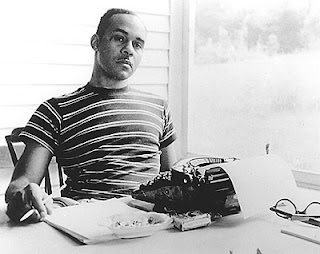
Still from the film "Ralph Ellison: An American Journey" It seems to me that Ralph Ellison may be this country's most important writer. Not so much for his production or even his style, but because of his deep wisdom and his remarkable understanding of the links between literature, politics, and our national struggle with the culture of identity. Every time I read essays like "Indivisible Man," "The Novel as a Function of American Democracy," or "Going to the Territory," I find a new perspective on life and am constantly amazed by the little jewels of truth that sparkle beneath the waters of Ellison's words. The greatest influence on Ralph as a writer was Fyodor Dostoevsky. Invisible Man was Ellison's "Notes from the Underground." To me, Ralph Ellison did so much more than elevate Dostoevsky to the 20th century. He pointed at the universality of true human experience, that push and pull of soul, identity, culture, politics...

Citadel on the Mountain

When we set out on our journey to Richmond, it never occurred to me that I would have a story to tell. I took some notes on thoughts I was having at the time. I wrote in my journal some. But I never intended to write out this story. It just came to me over the course of the end of 2003, sort of as an unrelenting need to struggle with what had happened to me--especially the strange sleepy sensations I was having and the vague auditory hallucinations. I could not even have conceived of writing the story of our quest for Dana without having read Dick Wertime's Citadel on the Mountain several years ago (see "true links" to the right for a sample from the book, or click on the title of this entry to go to Amazon). Citadel is Dick's memoir of growing up with a father who was brilliant, intense, possibly connected to the CIA, and also at times paranoid and delusional. Dick's story is about trying to understand his father (and himself) after his father had died, realiz...

Once and Future Worlds

The Acadians of the Maritime Coast in Canada were a fully integrated culture mixing Native and French cultures over the course of several centuries prior to the Revolutionary War. They were a culture of some 18,000 people wiped out in a few years by the British, utterly eliminated through forced removal or simply driven into the wilderness to fend for themselves. Some of these displaced Acadians eventually straggled down to Louisiana. Over the next century (mostly the 19th), French/Creole language shifts eventually came up with the name Cajuns for them. An article in Salon.com contains an extended interview with John Mack Faragher, a Yale professor of history, who wrote the book entitled, "A Great and Noble Scheme." The article can be found at Salon's website in the books section, "America's Forgotten Atrocity." Here's an interesting clip from the article: " To what extent should the Acadians be viewed as a mixed-race or an ethnically mixed people?...